



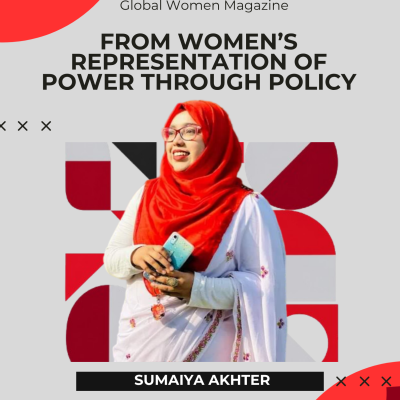
From Women’s Representation of Power through Policy
Women’s representation is often celebrated as evidence of progress. We see more women entering universities, becoming academics, serving on committees, taking leadership positions, and participating in professional organisations. Yet an important question remains: How much influence do women actually have over the decisions that shape these institutions and, ultimately, society?

This question becomes particularly relevant in the Global South, where women’s numerical representation can sometimes coexist with deeply embedded structures of unequal power.
“Political tokenism will not empower women,” an editorial from The Daily Star, a Bangladeshi news portal, published on 5 May, 2024, showed concern and critically examined women’s reserved seats in Bangladesh’s parliament. The editorial questions whether increasing the number of reserved seats has necessarily translated into political empowerment, noting that representation without authority, resources, and meaningful participation in decision-making can remain largely symbolic. The same question deserves to be asked about women in academia.
A university may have a substantial number of female lecturers and professors, but how many women are involved in designing institutional policies? How many influence recruitment, promotion, research funding, curriculum decisions, or strategic planning? How many are being prepared and sponsored for senior leadership?
Representation is the starting point, not the destination.
Women academics have enormous potential to influence policy because they operate at the intersection of knowledge, practice, and society. They are not only researchers. They observe classrooms, supervise students, engage with communities, conduct research, and experience institutional structures firsthand. Their work can generate evidence for policies on education, gender equality, digital access, workplace rights, curriculum reform, and social development.
However, expertise cannot influence policy if women remain outside the rooms where important decisions are made.
This is where institutional empowerment needs to move beyond symbolic inclusion. A woman being appointed to a committee is meaningful only when she has the opportunity to contribute, question decisions, access information, and influence outcomes. A leadership title means little if authority over budgets, staffing, research opportunities, or institutional strategy remains elsewhere.
This issue is not unique to Bangladesh. Across the Global South, women professionals frequently navigate social expectations alongside institutional hierarchies. Academic excellence does not automatically eliminate these barriers.
Women may be highly qualified yet expected to remain accommodating, grateful, or patient while waiting for opportunities that are repeatedly deferred.
This is why mentorship and sponsorship matter. Institutions should not simply encourage women to work harder. They should actively create pathways through which qualified women can enter leadership, policy consultation, research networks, and international decision-making spaces.
Women academics can also become important bridges between local and global knowledge. Research emerging from Bangladesh, Nigeria, Nepal, India, Pakistan, or other Global South contexts can challenge assumptions developed primarily within Western academic and policy environments. Women’s experiences within these societies can contribute perspectives that are often missing from international discussions about education, development, technology, gender, and work.
The goal, therefore, should not simply be to put more women in the room.
It should be to give them the authority to shape what happens in the room.
The lesson from political representation applies equally to academia: numerical inclusion can create visibility, but meaningful empowerment requires voice, resources, authority, accountability, and access to decision-making.
Women academics are already producing knowledge capable of influencing policy. The next step is for institutions to recognise them not merely as participants in education, but as policy thinkers, institutional decision-makers, and contributors to global knowledge production.
Because when women move from being represented to being heard, and from being heard to having influence, representation finally becomes empowerment.

Similar Deep Dives
Women, Policy, and the Long Game of Global Influence