





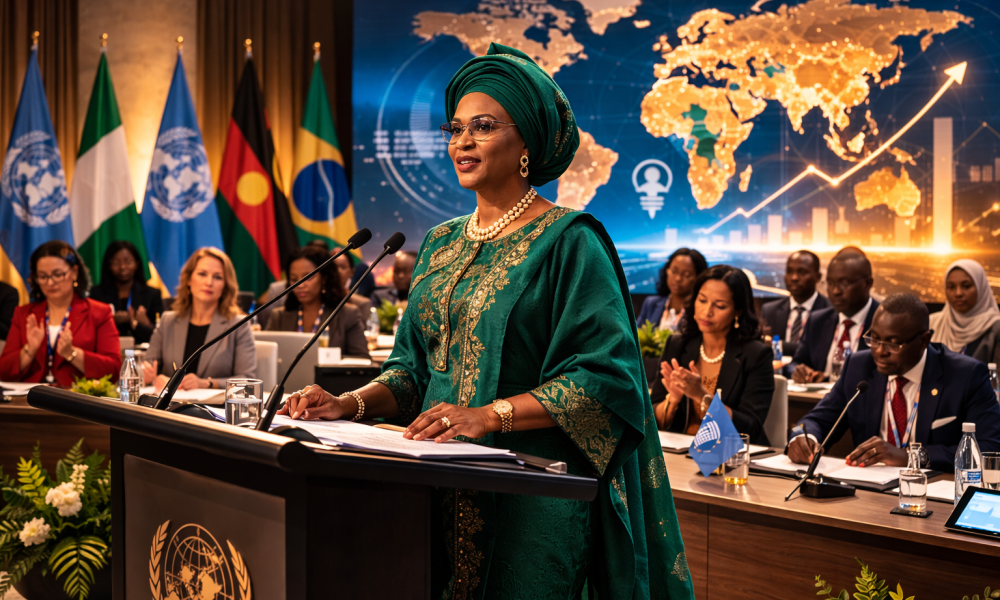
Nigeria has reaffirmed its commitment to advancing gender equality on the global stage, as the country’s Minister of Women Affairs presented renewed national priorities at the Global Leaders’ Meeting on Women this week.
Addressing international policymakers, development partners, and institutional stakeholders, the Minister outlined strengthened policy frameworks designed to accelerate women’s economic participation, political inclusion, and protection from gender-based violence. Central to the presentation was a clear emphasis on financing strategies, underscoring that gender equality must be embedded within national budgeting systems rather than treated as a peripheral social initiative.
The renewed commitments reportedly focus on:
- Expanding women’s access to capital and enterprise support
- Strengthening legal and policy protections for women and girls
- Increasing women’s representation in leadership and decision-making roles
- Enhancing accountability mechanisms to track measurable progress
By highlighting actionable frameworks over aspirational declarations, Nigeria positioned gender equity as a governance priority linked to national development outcome.
From a global leadership lens, moments like these are less about announcement and more about architecture.
Across emerging and established economies alike, the most effective gender reforms are those anchored in structured financing and institutional accountability. When governments align policy design with budgetary commitment, gender equality shifts from advocacy language to statecraft.
Nigeria’s reaffirmation signals participation in a broader global trend: reframing women’s advancement as economic infrastructure. The critical question now is implementation, how commitments translate into procurement policies, workforce reforms, digital access expansion, rural inclusion strategies, and sustained funding mechanisms.
In the evolving global equity landscape, credibility is built not through pledges, but through measurable execution.
As 2026 policy cycles unfold, Nigeria’s next phase will likely be assessed not only by intent, but by institutional delivery.






No Comment! Be the first one.