




The standard narrative of women’s leadership has been strictly quantitative. Headlines and gender-equity reports routinely anchor their analysis on standard benchmarks: headcounts of female CEOs, board seat allocations, political representation, and venture-backed founders. While tracking representation remains necessary, it is no longer sufficient. Presence does not equate to power, a formal title is not synonymous with influence, and high visibility rarely guarantees institutional impact.
A leader can hold an executive office yet remain constrained by surrounding institutional mechanics. Conversely, leaders who never appear on traditional listicles often shape regulatory policy, transform organizational architecture, drive market access, and institute operational systems that endure long past their tenure.
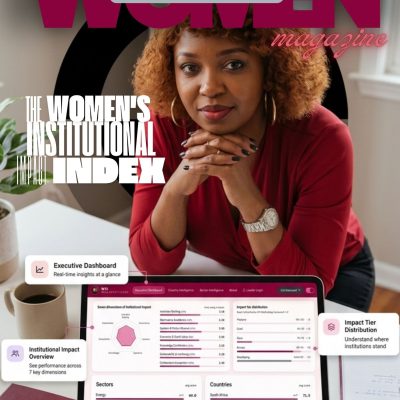
This core distinction underpins the Women’s Institutional Impact Index (W3I); a leadership intelligence framework created by SHELEAPS™ to reform how women’s professional influence is tracked, analyzed, and preserved. Under August’s core theme, “Building Authority Without Apology,” the focus shifts from surface representation to systematic measurement.

The Limits of the Visibility Economy
Modern corporate and civic cultures excel at measuring representation metrics. Public platforms seamlessly aggregate audience reach, media appearances, keynote engagements, awards, and job titles. However, these metrics fail to evaluate institutional outcome; the structural changes resulting from a leader’s tenure.
WIII replaces popularity metrics with evidence-based intelligence, asking a crucial fundamental question: What structural shifts occur because a leader is present?
To answer this, the framework moves beyond biographical profile summaries to evaluate leadership architecture through key vectors:
- Systemic Changes: The concrete policies, regulatory shifts, and governance models initiated.
- Institutional Durability: The structural vitality of the organization post-tenure.
- Economic & Value Creation: The expanding access to capital, markets, and institutional pipelines.
- Knowledge Assets: The institutional research, frameworks, and operational intellectual property contributed.
Constructing Leadership Memory
A primary vulnerability in tracking female executive leadership is systemic under-documentation. Long-term institutional overhauls (such as restructuring governance, designing policy, expanding economic access, or establishing talent pipelines) frequently fade from organizational memory once a executive steps down.
When structural contributions are not captured systematically, institutional memory decays. W3I operates as a structured repository; an intelligence layer designed to document not just that an executive holds authority, but precisely how that authority reshapes systems.
+-----------------------------------------------------------------------------------+
|                        SHELEAPS™ DOCUMENTATION FRAMEWORK                        |
+------------------------------------------+----------------------------------------+
| Dimension                                | Operational Focus                      |
+------------------------------------------+----------------------------------------+
| Institution Building & Governance        | Structural longevity, framework design |
| Systems & Policy Influence               | Regulatory shifts, institutional norms |
| Economic & Social Value Creation         | Market access, enterprise growth       |
| Knowledge & Intellectual Contribution    | IP creation, strategic methodology     |
| Ecosystem & Continuity Impact            | Pipeline development, legacy systems   |
+------------------------------------------+----------------------------------------+
From Static Index to Intelligence Platform
Rather than operating as a fixed annual ranking, W3I functions as a dynamic Leadership Intelligence Platform. Standard indices offer a static snapshot of rank; an intelligence environment maps systemic dynamics across sectors and regions.
The WIII infrastructure incorporates targeted analytical modules:
- Executive Dashboards & Leader Profiles: Data-driven views of individual leadership trajectory and output.
- Country & Institution Insights: Comparative cross-sector analysis mapping where institutional authority translates into measurable outcomes.
- Data Explorer & Research Centre: Primary data sources for policymakers, corporate leaders, and researchers evaluating gender-driven systemic development.
Building on established recognition initiatives like the Global Women of Choice Awards, this intelligence platform transitions the conversation from validation (“recognizing what was done”) to structural analysis (“understanding how authority scales”).
Ultimately, establishing authority without apology requires moving past permission-seeking narratives. By building verifiable records of institutional impact, leadership shifts from simple representation to permanent structural transformation.

Similar Deep Dives

Women, Policy, and the Long Game of Global Influence
From the page of an Academician