





Building Systems, Shaping Perception, and Redefining the Architecture of Modern Power
Influence is often mistaken for attention.
But real influence is structural.
It shapes who gets heard, who gets funded, who gets invited into rooms where decisions are made—and ultimately, who gets remembered.
This June, The Global Women Magazine proudly features Christina Paap, entrepreneur, media strategist, ecosystem builder, and 2026 Global Women of Choice Honouree, whose work exists at the intersection of media, entrepreneurship, and strategic positioning.
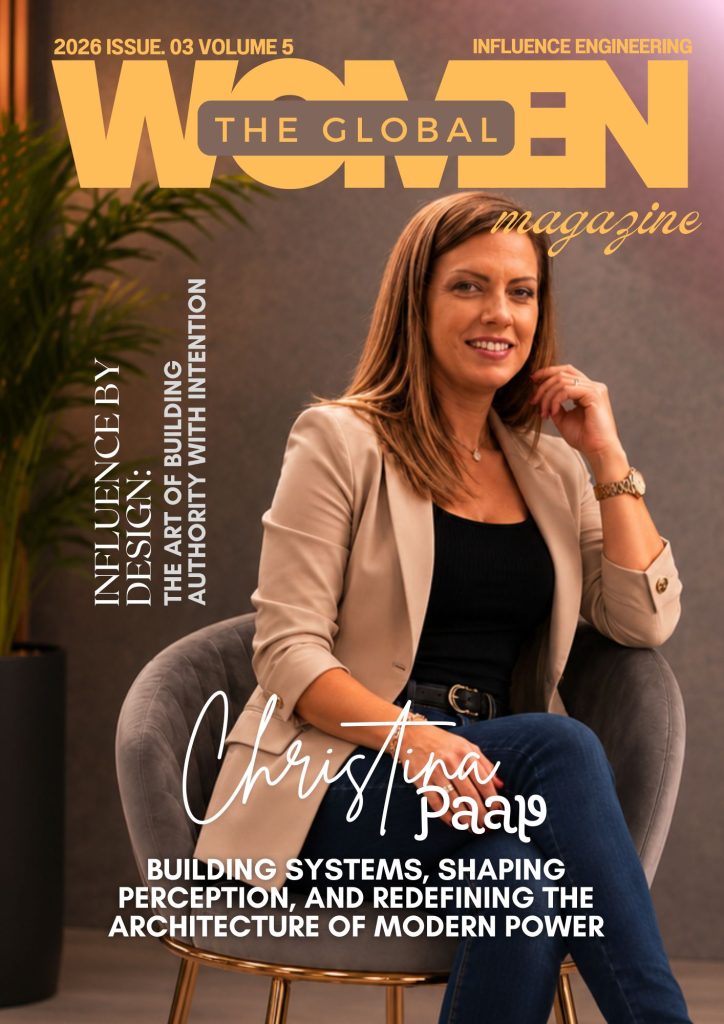
In an era dominated by noise, Christina represents something far more powerful: intentional influence engineered for long-term impact.
Beyond Visibility
For Christina Paap, relevance is never accidental.
“It is the result of structure, mindset, and the right connection between people and ideas,” she explains.
This philosophy has become the foundation of her work across media, innovation, and entrepreneurship. While many build audiences, Christina builds systems. While others chase visibility, she focuses on meaning.
Her leadership philosophy is rooted in one defining idea:
the most powerful leaders do not simply communicate—they shape perception itself.
“When I bring together founders, investors, and institutions, I don’t think in networks,” she says. “I think in systems.”
This distinction matters.
A network is proximity.
A system is infrastructure.
And Christina has spent years engineering environments where collaboration becomes sustainable, strategic, and transformational.
Media as Infrastructure
One of the most compelling aspects of Christina’s work is the way she reframes media—not as publicity, but as architecture.
“For me, media is infrastructure,” she says. “It determines how information flows, how it is interpreted, and who gains access to it.”
In finance and entrepreneurship especially, she has observed how narratives quietly shape opportunity. Media influences who investors trust, whose expertise is legitimized, and which ideas are positioned as “important.”
This realization fundamentally shaped her approach.
She does not see media as a downstream marketing function. She sees it as a strategic force capable of altering business outcomes, institutional access, and long-term positioning.
“What many underestimate,” she explains, “is that reach is not a substitute for influence.”
True influence, according to Christina, is built through:
- Context
- Credibility
- Strategic positioning
- Presence in the right rooms
This is the essence of Engineering Influence: understanding that perception is not superficial—it is economic, institutional, and deeply consequential.
Building Ecosystems That Last
Through initiatives like the Innovation Award and the Entrepreneurs Club, Christina has consistently demonstrated her ability to move beyond event culture and into ecosystem design.
From the beginning, her vision was clear:
create platforms that generate real collaboration—not performative networking.
Today, those platforms connect entrepreneurs, investors, institutions, and innovators through structures designed for longevity.
“Growth matters,” she says, “but not at any cost.”
It is a philosophy that has shaped her leadership style:
less, but better. Clearer, but more impactful.
In an era obsessed with scale, Christina prioritizes relevance. She understands that the strength of a platform is not determined by how many people enter the room—but by what happens after they do.
Her ecosystems integrate:
- Visibility
- Access to capital
- Strategic knowledge
- Institutional credibility
Not as isolated functions, but as interconnected systems that reinforce one another over time.

Storytelling as a Leadership Tool
For Christina, storytelling is not decoration. It is governance.
“Storytelling is not an add-on for me,” she explains. “It is a core leadership instrument.”
This philosophy became especially visible through Mission Undercover, a project intentionally designed to challenge traditional formats and demonstrate the power of narrative in shaping public perception.
“We are highly intentional about the stories we tell,” she says. “It’s not about being loud—it’s about being relevant.”
This commitment to strategic storytelling reflects a deeper understanding of influence itself: the stories society amplifies become the realities it normalizes.
Film, media, and narrative are therefore not passive tools—they are mechanisms that shape culture, economics, and leadership perception.
Christina’s work recognizes that leaders today are not only responsible for what they build, but also for the narratives surrounding what they build.
The Future of Entrepreneurial Influence
Over the next decade, Christina’s vision is ambitious but precise:
to further integrate media and entrepreneurship into one unified strategic system.
Her work through Vogt & Paap reflects this long-term positioning strategy—one built on clarity, analysis, and execution with substance.
“No positioning without substance,” she says. “And no strategy without long-term impact.”
This philosophy cuts against the increasingly performative nature of modern business culture. Christina is not interested in visibility without value, branding without depth, or influence without infrastructure.
Instead, she is engineering something more enduring: a model where media becomes a driver of entrepreneurial success itself.
Because those who understand perception, she argues, understand markets.
Recognition Beyond Projects
As a Global Women of Choice Honouree, Christina views recognition through a systems lens—not as acknowledgment of isolated achievements, but as affirmation of a body of work creating measurable, long-term impact.
“When leadership is documented at an institutional level,” she reflects, “the perspective shifts.”
Leadership becomes less about individual moments and more about:
- the systems created
- the structures sustained
- the opportunities expanded over time
For Christina, this recognition carries responsibility.
“I see this as a responsibility to build things that last,” she says. “Not only visible—but effective.”
And perhaps that is the clearest definition of influence itself.
Not noise.
Not attention.
Not temporary relevance.
But structures that continue shaping outcomes long after the spotlight moves on.
Engineering the Future
The future of leadership belongs to those who understand that influence is not accidental. It is designed. Structured. Engineered.
Christina Paap represents a new generation of strategic leadership—one that understands media, entrepreneurship, perception, and systems not as separate disciplines, but as interconnected forces shaping the future of global influence.
In a world flooded with visibility, she reminds us that substance still matters.
That positioning without purpose eventually collapses.
And that the most powerful leaders are not always the loudest ones—but the ones building the frameworks everyone else eventually operates within.
This is not simply leadership.
This is influence by design.
Pull Quote
“Reach is not a substitute for influence. Influence is built through context, credibility, and the ability to be present in the right rooms at the right time.” — Christina Paap

Similar Deep Dives

Why Modern Enterprises Are Built on Trust, Not Attention
How Women Are Building Power on Their Own Terms