




At some point in most women’s careers, there’s a moment of reckoning. You’ve done the work. You’ve built the skills. You’ve sat in rooms you had to fight to get into, contributed ideas that quietly became policy, and mentored people who are now several rungs above you on the ladder you helped them climb. And yet the metric you’ve been handed, the one that supposedly measures whether you’re succeeding, is still visibility. Followers. Presence. Personal brand.
It’s exhausting. And I’d like to suggest it’s the wrong game entirely.
Not because visibility doesn’t matter. It does, and women, in particular, can’t afford to be invisible in spaces where decisions get made without them. But there’s a meaningful difference between visibility as a tool and visibility as the goal. One serves your work. The other just serves your ego, and your ego, however well-deserved its confidence, is not what’s going to change anything for the women who come after you.
Legacy is…
What Legacy Actually Means
When most people hear “legacy,” they picture something grand and posthumous. A building with your name on it. A Wikipedia page. A TED Talk that keeps circulating ten years later. And sure, if that’s your thing, go for it, I hear the catering at those events is excellent.
But the legacy I’m talking about is quieter and, I’d argue, far more powerful. It’s the culture you shaped in an organization that still shows up in how people treat each other after you’ve left. It’s the woman you sponsored five years ago who just got a board seat. It’s the decision you pushed for that permanently changed how your industry thinks about something. It’s the room that’s different because you were in it.
That kind of legacy that doesn’t always photograph well. It doesn’t generate engagement. It doesn’t show up in your metrics dashboard. But it compounds in ways that visibility simply cannot match.
The Visibility Treadmill
Here’s the thing about chasing visibility: it accelerates. The more you build, the more you need to maintain it. The audience you grew wants content. The platform you established needs feeding. The personal brand you’ve carefully constructed requires constant tending, or it starts to feel stale, or worse, irrelevant.
I’ve watched brilliant women pour extraordinary energy into staying visible, posting consistently, showing up on every panel, engineering a presence that looks effortless and costs everything. And I understand the logic. In a world that systematically overlooks women, being seen feels like survival. It is, sometimes.
But visibility without depth is a performance. And performances end.

The women I most admire, the ones whose influence genuinely outlasts the rooms they occupied, aren’t the ones who were most visible. They’re the ones who were most deliberate.
They chose carefully where to invest their energy, who to develop, what to stand for, and what they were willing to be unpopular about. They weren’t building an audience. They were building something.
Feminine Leadership Was Always Playing the Long Game
Here’s a reframe I’ve been sitting with: what we’ve long called “feminine” leadership styles were never soft. They were long-horizon.
Empathy, relationship-building, collaborative decision-making, investing in the growth of others, these don’t produce immediate, visible results. They don’t make for punchy LinkedIn content. They’re not the kind of wins you can announce in a team meeting. But they are exactly how you build organizations that function well after you’re gone, teams that carry a culture forward, and people who go on to do meaningful things partly because of how you led them.
Legacy-oriented leadership has always looked like this. It just wasn’t recognized as strategic because the results weren’t immediate and the people doing it were, disproportionately, women.
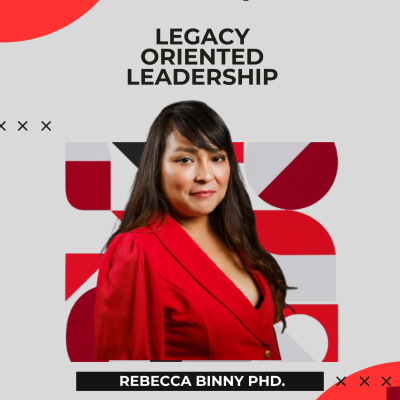
-rebecca binny phd.
The shift happening now, slowly, loudly, with significant resistance from people who’ve built comfortable careers on the old model, is a recognition that the leadership qualities we told women to downplay are precisely the ones required for the complexity of this moment. Organizations navigating genuine disruption need leaders who can hold a room not through volume but through trust, who make decisions that account for more than the next quarter, and who build bench strength rather than dependence.
That’s not a nice-to-have. That’s survival strategy. And a lot of women have been running it for years.
Practical, Which I Know You Need
So what does choosing legacy over visibility actually look like on a Tuesday?
It looks like sponsoring someone, not just mentoring them, but putting your name behind their advancement in a room they’re not in. Mentoring is advice. Sponsorship is risk. Legacy is built through risk.
It looks like being the person who says the true thing in the meeting, even when the true thing is uncomfortable, because you’ve decided that your reputation for honesty is worth more than your reputation for agreeableness.
It looks like building systems and processes that work without you, instead of creating structures that require your continued involvement to function. Leaders who make themselves indispensable are securing their own position. Leaders who make themselves unnecessary are building something that lasts.
It looks like knowing what you want to be remembered for and letting that guide decisions, especially the small ones. Legacy isn’t built in grand gestures. It’s built in the accumulated choices about how you showed up, what you tolerated, who you championed, and what you refused to let slide.
The Real Flex
Visibility is easy to measure. Legacy isn’t. And in a world that loves a metric, that’s genuinely hard. It requires trusting that the work matters even when you can’t immediately point to results. It requires a certain security in your own sense of purpose that doesn’t depend on external validation to stay intact.
That’s not nothing. It’s actually one of the harder things to develop as a leader, and the women who’ve done it are formidable in a way that no follower count can replicate.
Being known is fine. Building something worth knowing about is better.
That’s the shift. And once you make it, you don’t really go back.

Similar Deep Dives

The Art of Becoming Unforgettable
How I Learned to Run Operations With AI as My Partner