



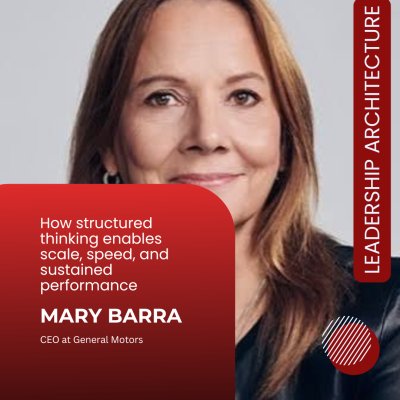
How structured thinking enables scale, speed, and sustained performance
At the highest levels of leadership, success is rarely the result of individual effort alone. Organizations that operate at scale require something more dependable than personality, energy, or even talent.
They require systems.While many leaders focus on strategy and vision, the leaders who transform industries understand that long-term performance depends on the structures that sit beneath those ideas — the mechanisms that allow decisions to move faster, teams to align more clearly, and execution to remain consistent even in complex environments.
This is what defines leadership architecture: the deliberate design of systems that allow organizations to function at their highest potential.
Few leaders illustrate this better than Mary Barra. Under her leadership, General Motors has undergone one of the most ambitious transitions in modern manufacturing, moving from a traditional automotive giant toward an electric and technology-driven future. Achieving this kind of transformation requires more than bold announcements. It demands systems capable of supporting change at scale.
Across industries, high-level leaders tend to build five core systems that sustain performance.
1. The Decision System
Every organization makes decisions.But high-performing organizations design how decisions are made.
Without a clear decision system, leaders become bottlenecks. Teams hesitate, alignment weakens, and speed disappears.
High-level leaders create decision systems that define: who owns which decisions, what information matters most, how quickly choices must be made, and how risk is evaluated.
This reduces ambiguity and enables momentum.
At General Motors, transformation into electric mobility required thousands of decisions across engineering, supply chains, manufacturing, and strategy. Such scale cannot rely on central authority alone. Structured decision pathways allow organizations to move forward without waiting for constant executive approval.
This is where scale begins.
2. The Alignment System
One of the most underestimated challenges in leadership is alignment.As organizations grow, complexity increases. Departments pursue different priorities, timelines shift, and communication gaps appear. Without deliberate alignment systems, even strong strategies fail during execution.
Alignment systems ensure that: leadership priorities cascade clearly through the organization, teams understand how their work connects to the larger mission, and progress is measured consistently.
Under the leadership of Mary Barra, General Motors has had to align thousands of employees around a long-term shift towards electric vehicles, software integration, and sustainable mobility.
This type of transformation only succeeds when the organization moves in the same direction at the same time.
Alignment systems make that possible.
3. The Execution System
Vision without execution is aspiration.
Execution systems translate strategy into consistent operational movement.
They define: how work flows across teams, how progress is monitored, how obstacles are resolved quickly, and how accountability is maintained.
In large organizations, execution cannot rely on constant intervention from leadership. Instead, it must operate through clearly defined processes that enable teams to deliver outcomes without friction. For companies navigating technological transformation, as General Motors is today, execution systems become especially critical. Innovation, manufacturing, and long-term product development must operate simultaneously, without losing speed or coordination.
This is how strategy becomes visible in real-world results.
4. The Talent and Leadership System
Organizations do not scale through strategy alone. They scale through people, specifically, leaders who can operate within and strengthen the system itself. High-level leaders invest heavily in leadership pipelines that ensure: decision-making capability exists at multiple levels, future leaders are developed intentionally, and cultural standards are reinforced across teams.
One of the defining traits of structured leadership is the ability to build leadership beyond oneself.
For Mary Barra, leading one of the world’s largest automotive companies means cultivating leadership across engineering, innovation, operations, and global markets simultaneously.
Without a strong leadership system, organizations eventually stall. Not because of strategy failure, but because leadership capacity cannot keep up with growth.
5. The Adaptation System
The final system (and perhaps the most critical in today’s environment) is adaptability.
Industries evolve. Markets shift. Technology accelerates change. Leaders who rely solely on fixed strategies struggle to respond.
Adaptation systems ensure that organizations can: learn quickly, adjust direction when needed, identify emerging opportunities early and remain competitive in shifting environments.
General Motors’ transition toward electric vehicles, autonomous technologies, and new mobility models demonstrates how adaptation must be built into the structure of leadership. Not added as an afterthought.
It is not enough to react to change.
High-level organizations design the ability to move with it.
Structured Thinking and Leadership Scale
What connects all five systems is structured thinking.
Structured leaders do not approach leadership as a sequence of responses. They approach it as a system of design , shaping how decisions, people, execution, and adaptation interact across the organization.
This is what enables: scale without chaos, speed without confusion, and performance without burnout.
It also ensures that leadership is not concentrated in a single individual, but distributed across the organization in a way that strengthens resilience.
Rethinking Leadership at Scale
Leadership conversations often focus on vision, motivation, and communication. While these elements remain important, they are not sufficient for organizations operating in complex environments.
High-level leadership requires the ability to build systems that function under pressure, grow with the organization, and remain effective even as circumstances change.
The leadership architecture demonstrated by Mary Barra reflects this shift, from leadership as direction to leadership as design.
And this is where the distinction becomes clear.
The leaders who create lasting impact are not simply those who guide organizations forward.
They are the ones who build the systems that allow those organizations to continue moving, long after the initial decision has been made.