




At the summit of leadership, strategic decision-making never happens in a vacuum. For high-level women navigating today’s complex global landscapes, a choice is rarely the result of internal logic alone. It is a sophisticated act of positioning. A way to move through competing priorities, external expectations, and the unspoken dynamics of power and perception.
For this second deep dive in our series, we examine how elite leaders integrate these forces into their process, turning friction into a tool for systemic resilience.
1. Decision-Making as Confrontation
Every strategic choice exists within a broader system; whether organizational, cultural, or market-driven. The challenge for a leader is not just choosing a direction, but mapping the terrain: Who is affected? Who holds the influence? Where will the resistance emerge?
Effective leaders pressure-test their assumptions by seeking out what we call “intentional friction.” Insights from Stratos Coaching suggest that the strongest decisions come from seeking the perspective most likely to dismantle your current thinking. In this arena, decision-making is not confirmation; it is confrontation. By building a process that invites challenge, leaders ensure their choices are not just internally sound, but externally bulletproof.
2. The Power of Selective Influence
While high-level leaders rarely act alone, they are ruthlessly selective about their advisory alliance. The most successful women build a “personal board of advisors”. Not as a symbolic network, but as a rigorous, functional decision-support system.
This framework prioritizes:
- Dissenting Voices: To break the echo chamber.
- Scenario-Based Challenges: To stress-test the “what-ifs.”
- Alternative Perspectives: To counteract the blind spots created by proximity.
The goal is never consensus; it is clarity under scrutiny.
3. Calculating the Cost of Inaction
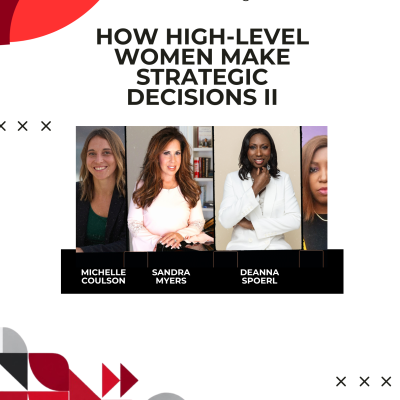
Strategic decisions are rarely judged the moment they are made; their value is revealed by the trajectory they set. For leaders like Michelle Coulson, the vital question isn’t “Is this safe?” but rather, “What is the real cost of not deciding?”
In high-stakes environments, indecision is often the greatest risk. Opportunities are time-bound, and the cost of delay is a hidden tax on growth. In shifting industries, the most effective leaders look beyond immediate validation toward long-term positioning.

Contributor: Michelle Coulson, Founder at Remote Rebellion
4. Holding the Emotional Weight
Not all decisions can be reduced to a spreadsheet. Many carry the heavy weight of personal and relational consequence. As DeAnna Spoerl notes, leaders must confront the visceral realities of their choices: What are you willing to sacrifice? What are you prepared to risk?
At the highest levels, leadership often requires:

Contributor: DeAnna Spoerl, Chief Brand Officer at Bear Icebox Communications
- Letting go of “comfortable” opportunities to prioritize growth.
- Ending an alliance that no longer serves the vision.
- Prioritizing long-term systemic health over immediate team comfort.
The hallmark of a great leader is the ability to hold both strategic clarity and emotional weight without letting either cloud her judgment.
5. Proximity vs. Perspective
There is a delicate balance between data and experience. Andrea Durre emphasizes the importance of proximity: the team closest to the situation often holds insights that numbers alone cannot capture.
However, perception can be skewed by being too close. High-level leadership requires a “zoom-in, zoom-out” capability—valuing the operational reality on the ground while interpreting those insights through the lens of brand identity and systemic impact.
6. Recalibration: Consistency vs. Rigidity
External pressures (market shifts, stakeholder demands, or sudden crises) require a leader to be fluid. Sadra Myers highlights that tying oneself too strictly to an initial plan can lead to missed opportunities for elevation.

Contributor: Sandra Myers, Co-Founder & President at Select Date Society
The Rule of Recalibration: Maintain your strategic direction, but stay tactically flexible. Do not abandon the vision, but remain willing to evolve the path you take to reach it.
The Illusion of Control
Perhaps the most persistent myth in leadership is that control equals better outcomes. In reality, a leader can rarely control the market or the reaction of others. What she can control is:
- How the decision is structured.
- How the risks are evaluated.
- How the response is designed.
Closing: Navigating the System
Leadership at this level is less about choosing a direction and more about navigating a system. The women leading today are not just making choices; they are architecting the conditions under which those choices succeed. They understand the forces shaping the world around them and, despite the noise, they move with unwavering clarity.

Similar Deep Dives

Architecture Before Representation