



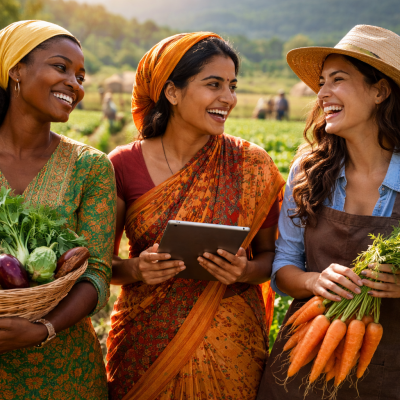
The Food and Agriculture Organization of the United Nations (FAO) has officially launched the International Year of the Woman Farmer 2026, placing long-overdue global attention on the women who form the backbone of food systems across continents—yet remain systematically excluded from power, resources, and recognition.Women make up a significant share of the world’s agricultural workforce, particularly in low- and middle-income countries, where they are responsible for planting, harvesting, processing, and sustaining household food security. Despite this, the FAO notes that women farmers continue to face persistent gender gaps in access to land ownership, agricultural finance, modern tools, training, and decision-making authority.The International Year is intended to catalyze policy reform, investment, and data-driven action to close these gaps. FAO officials emphasized that empowering women farmers is not a symbolic gesture, but a strategic necessity. Studies consistently show that when women farmers have equal access to resources, farm productivity increases, nutrition outcomes improve, and communities become more resilient to climate and economic shocks.Yet progress has remained slow. In many regions, women farm land they do not legally own, work without access to credit, and are excluded from agricultural cooperatives and policy tables where decisions affecting their livelihoods are made. Climate change has further intensified these inequities, as women farmers are often the least supported yet most exposed to environmental disruption.From our perspective, the launch of the International Year of the Woman Farmer is both necessary and quietly indicting. It forces a global admission of what has long been true: the world relies on women’s labor to feed itself, while denying them the authority to shape the systems they sustain.This is not a knowledge gap. It is a power gap. Women farmers have expertise passed down through generations, yet are treated as beneficiaries rather than architects of agricultural policy. Recognition without redistribution will not be enough.If the International Year of the Woman Farmer is to matter, it must move beyond celebration toward enforcement—land rights reform, gender-responsive financing, climate adaptation tools designed with women at the center, and guaranteed representation in agricultural governance.Food security is not gender-neutral. And neither is leadership. By naming 2026 as the year of the woman farmer, the FAO has opened a window for change. Whether governments and institutions step through it will determine not just the future of women in agriculture, but the resilience of global food systems themselves.

Similar Deep Dives