



Why enduring leadership is built on systems, not personality
Leadership has long been misunderstood as a function of presence.Charisma, confidence, and communication have been positioned as the defining traits of effective leaders. In many cases, they are.
Charisma can mobilize teams, inspire confidence, and create momentum in moments of uncertainty.
But charisma does not scale.And more importantly, it does not sustain.At the highest levels of leadership, where decisions carry long-term consequences and organizations must function beyond the individual, something else becomes far more important:structure.
The Limits of Charisma
Charisma is powerful, but it is inherently unstable.It depends on:the leader’s presencethe leader’s energythe leader’s ability to continuously engage and influence
This creates a fragile system — one where outcomes are tied too closely to the individual.
When the leader is absent, stretched, or replaced, the system weakens.
This is why charisma often produces short-term momentum but not long-term continuity.
Enduring leadership requires something more deliberate, something that does not rely on personality to function.
Leadership as Architecture
The shift from charisma to structure is best understood through what can be described as leadership architecture.
Leadership, at its highest level, is not performance.
It is design.
It is the intentional construction of:decision-making systems, operational frameworks, cultural standards, and accountability structures.
These elements create an environment where the organization can function, adapt, and grow. Regardless of who is in the room.
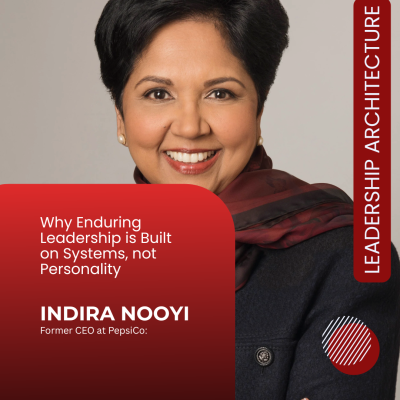
Few leaders exemplify this more clearly than Indra Nooyi.
Designing Beyond the Quarter
During her tenure at PepsiCo, Nooyi led one of the most significant strategic transformations in the company’s history.
Rather than focusing solely on short-term financial performance, she introduced a long-term framework that redefined how the company operated.
This approach (widely recognized as a shift toward sustainable growth) required more than vision. It required systemic change.
She embedded new priorities into the structure of the organization: product portfolio evolution, investment in healthier offering, integration of sustainability into business strategy, and alignment of leadership incentives with long-term goals.
This was not a branding exercise.It was architectural.
The goal was not to communicate a new direction, but to build it into how decisions were made across the company.
From Vision to System
One of the most defining characteristics of structured leadership is the ability to translate vision into repeatable systems.
Vision, on its own, is directional.Systems make it operational.
Nooyi’s leadership demonstrates this clearly. Her strategic direction was not left to interpretation. It was embedded into: how teams prioritized initiatives, how performance was measured, and how leadership was developed Internally.
This ensured that the organization did not rely on her presence to execute her vision. Instead, the system itself carried it forward.
Decoupling Leadership from Personality
A critical shift in high-level leadership is the separation of identity from execution.
Leaders who rely heavily on charisma often become the central point of decision-making. This creates bottlenecks and limits scalability.
Structured leaders do the opposite.
They distribute decision-making through: clearly defined frameworks, empowered teams, and aligned incentives.
This does not reduce control.It redefines it.
Control is no longer about direct oversight.It is about designing conditions that produce consistent outcomes.
Durability as a Measure of Leadership
The true test of leadership is not how well an organization performs under a leader’s tenure.
It is how well it continues to perform after they step away.
This is where structure becomes decisive.
Systems: outlast individuals, maintain direction, and absorb change.
Charisma cannot do this.
It cannot be transferred, scaled, or institutionalized.
Rethinking What Leadership Really Means
The distinction between charisma and structure is not about eliminating personality from leadership.
It is about placing it in the right context.
Charisma can: initiate movement, inspire belief, and create connection.
But structure:sustains performance, enables scale, and ensures continuity.
High-level leadership requires both, but it prioritizes what lasts.
Closing
Leadership is often judged by visibility, how a leader speaks, shows up, and commands attention.
But the most important work of leadership is often invisible.
It exists in:the systems that guide decisionsthe structures that shape behaviorthe frameworks that outlive the leader.
As demonstrated through the leadership architecture of Indra Nooyi, enduring impact is not built on personality. It is built on what remains when the leader is no longer the center of the system.
And that is the shift: From being the driver of outcomes to becoming the designer of them.